
Every decision, on the record.
Agents make hundreds of decisions a week. Gavel records every one and routes the few only the owner can answer, so nothing waits on a person who is not at the keyboard.

Internal to Renkara. Gavel is a tool Renkara Media Group builds and runs for itself. It is not for sale, and there is nothing to buy or join.
Proceed or hold, always written down.
An agent’s recorded decision, an ask that proceeds, a deploy that holds, the owner’s ruling, a reversal kept as a new revision, and ADR numbers from one allocator, all on StrataForge Robotics’ fictional records.
Read the film’s text version
Title: Gavel. Every decision, on the record. 2026. A bright, energized electronic score runs under the whole film, with a soft tick or hit on each action.
The hook: “Decided overnight.” A drawn wall of lane-log lines, labeled as an illustration, scrolls faster and faster, and one lit decision is carried off the top with the rest. “Lost by Friday.” “Where did it go?”
Record: As the beat drops: “What. Why. Undo.” A drawing of the record_decision call, filled in with a seeded decision’s own words: a weld-cell maintenance window moved to Wednesday, why, and how to undo it. “Then the owner reviews.” The real Review page, with “Awaiting review: 7” ringed and then the first decision, and seven marks, one per decision.
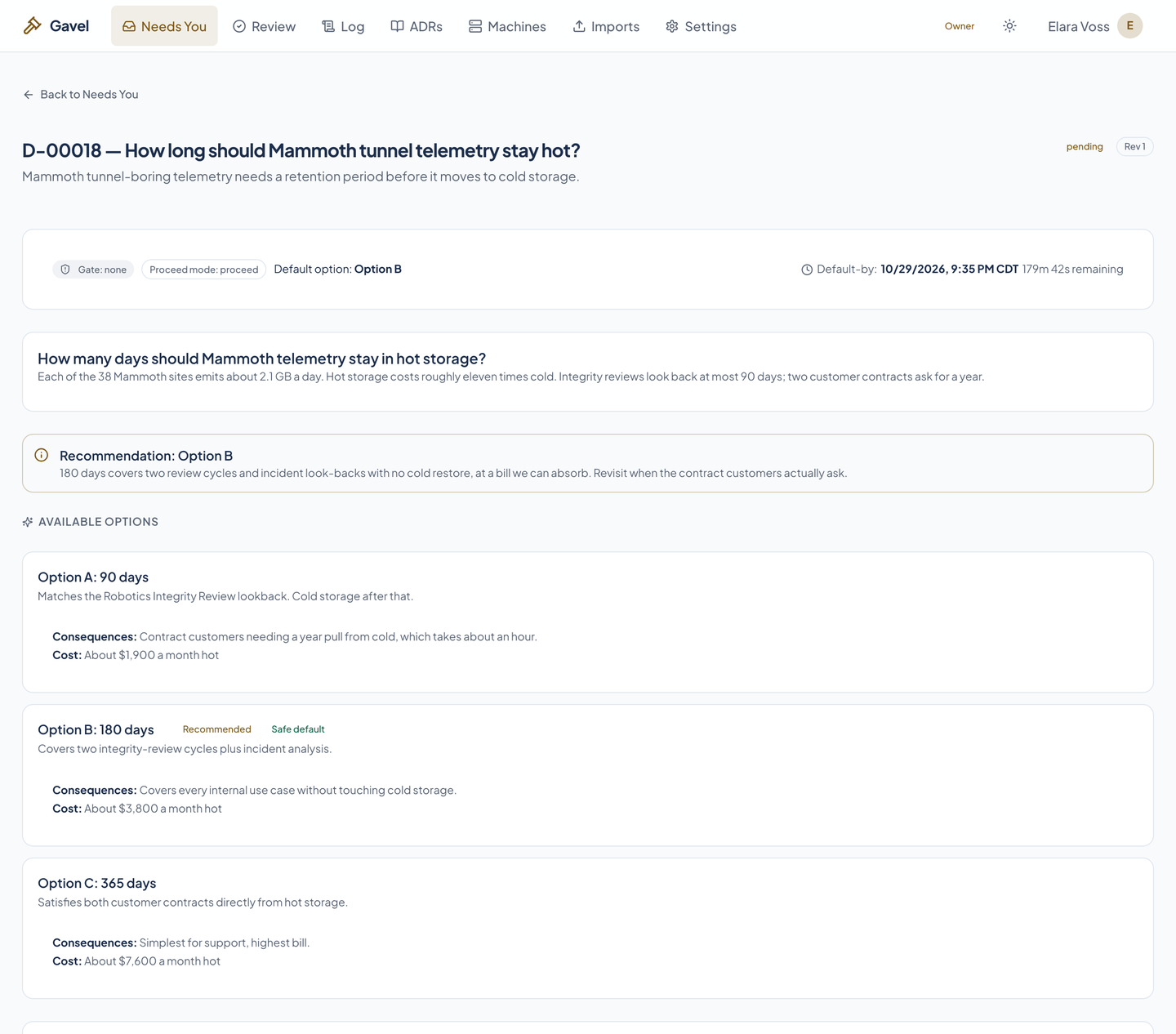
Ask: “Ask the owner.” The real Needs You page, with the pending count ringed and seven marks, three that proceed and four that are held. “Options. Recommendation. Default-by.” The real ask page for how long telemetry stays in hot storage, each part ringed in turn. “It keeps working.” A drawn flow, labeled as an illustration: ask filed, the agent keeps going on the recommendation, the owner or the clock closes it, and a default stays open for seven days.
Hold: As the beat drops again: “Some asks hold.” The real page for a firmware rollout, Sentinel 4.8.2 to 1,330 Colorado units, with its deploy gate and its hold mode ringed. A lock click lands as the gate is named.
Gates: “6 gates.” One pill per gate: deploy, spend, data-deletion, scope, owner-only, and infrastructure-security. The four that the queue holds in this demo are lit, and a line says two more are in the code.
The safe option: “The rollout holds.” Another drawing, labeled as an illustration: the agent’s other work finishes with checkmarks while the gated rollout sits behind a lock, in proceed mode hold. “No answer? The safe one.” Back on the real page, the gated option and the option marked as the safe default are ringed: a held ask nobody answers settles on its one safe default, never the gated one.
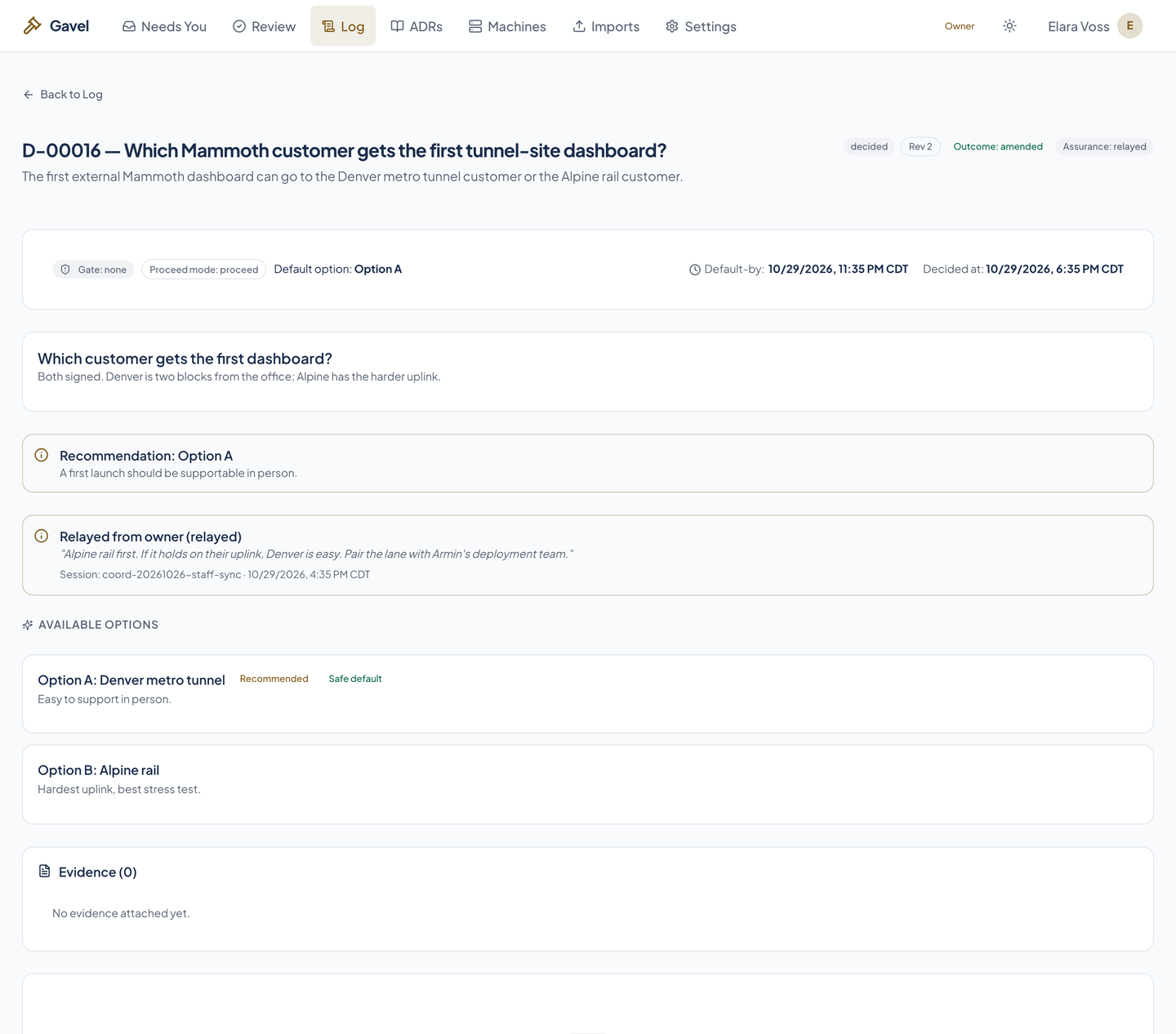
The ruling: “The owner rules.” The real ruling’s history row is ringed, and who, when, and route appear as the record holds them: Elara Voss, a Central time stamp, and web. “Web or Chirp.” A drawn phone card, labeled as an illustration, takes a tap, and the route reads chirp. “Or the clock does.” A drawn unanswered ask runs its timer out and shows Defaulted, with seven marks for the seven days left to confirm or reverse.
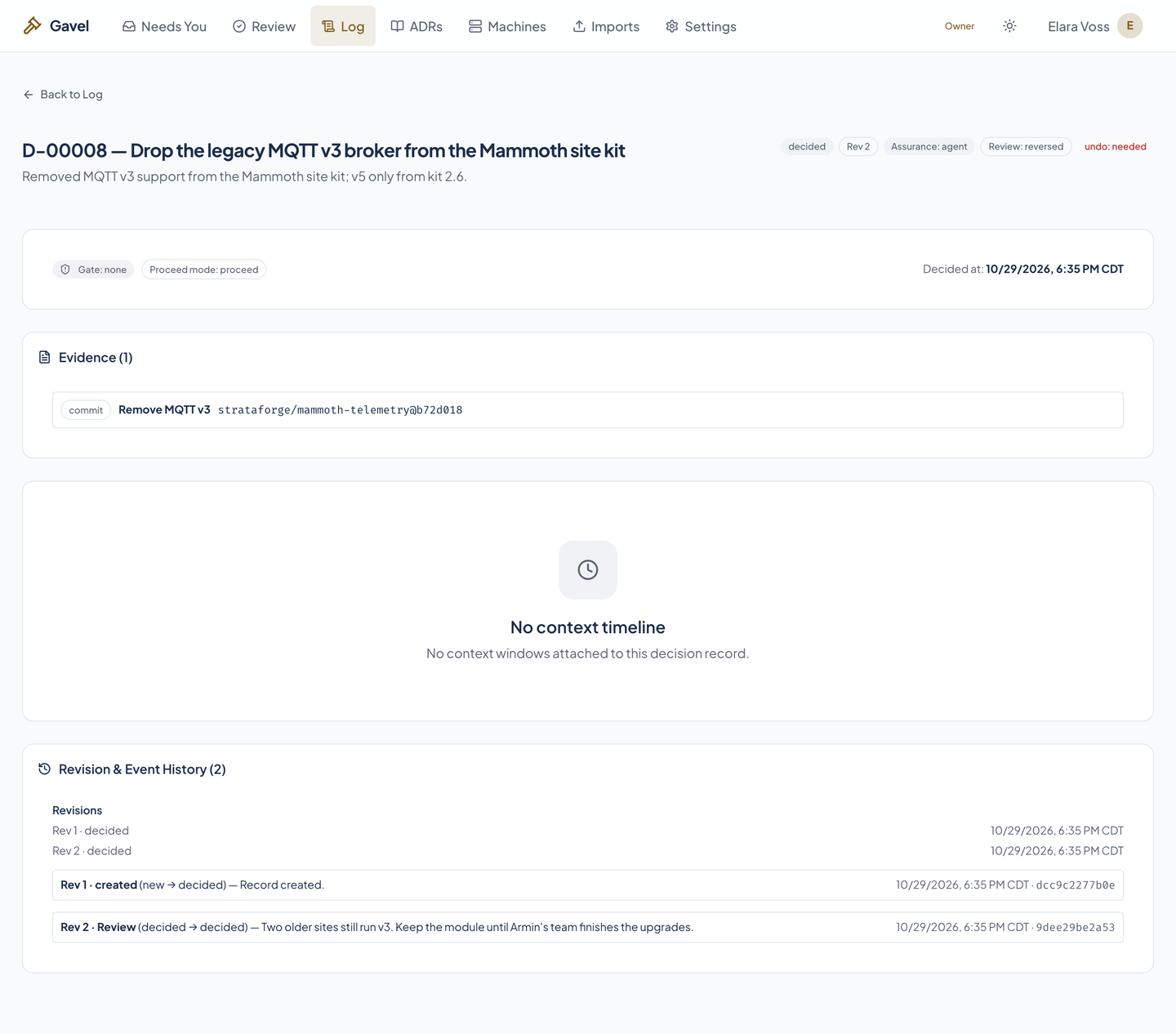
Revisions: “A reversal is a new revision.” The real history of a reversed decision, with its two revisions ringed and their hashes shown large and joined by a dotted line: each hash covers every event before it. “Try to edit one.” A drawn terminal, labeled as an illustration, shows the database’s refusal: “record_revisions is append-only.” “A check walks the chain.” Sixty-four marks turn green and a line reads “chain · ok · 64 of 64 events,” with a note that the diagnostics walk up to the newest 1,000 events.
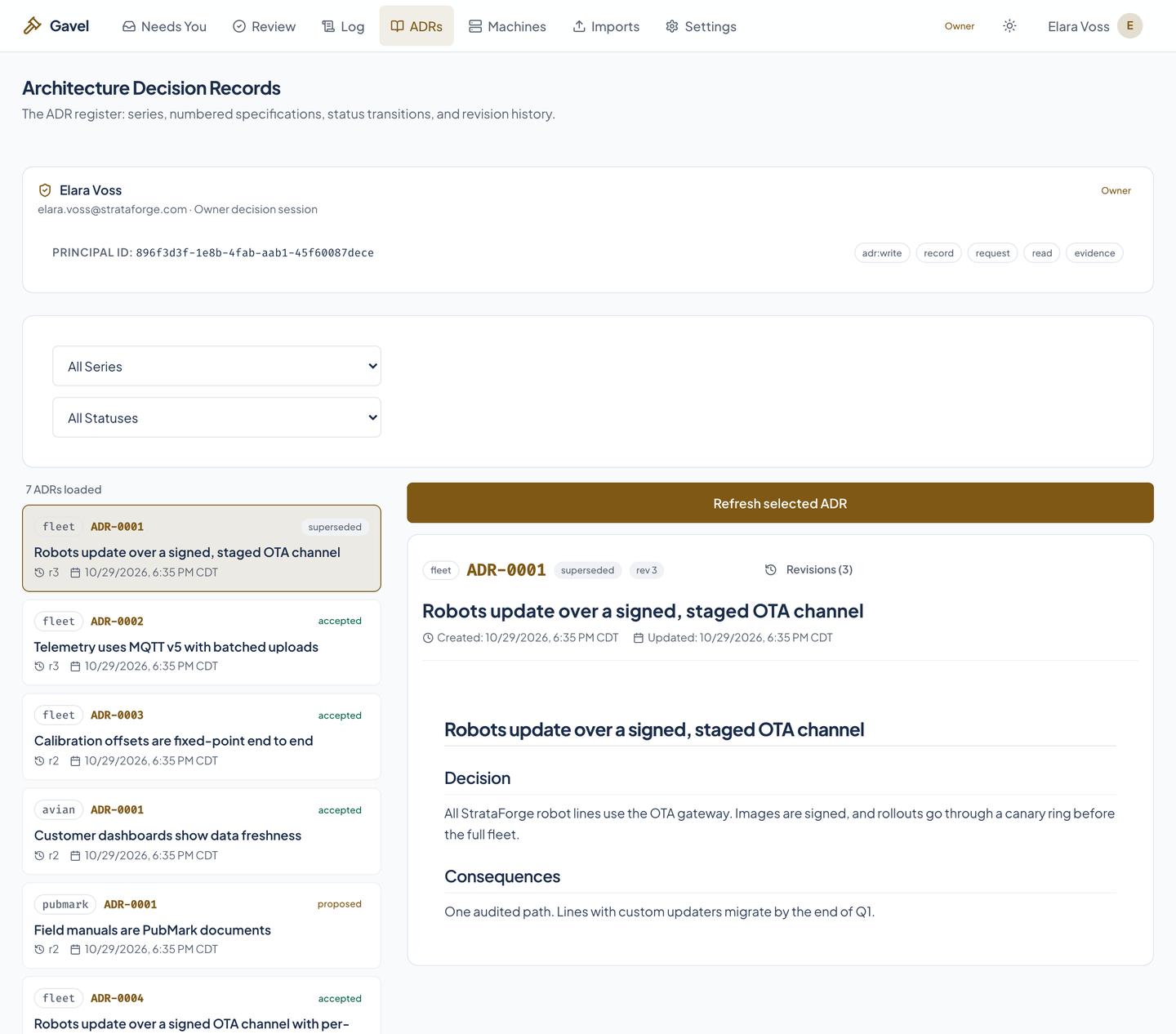
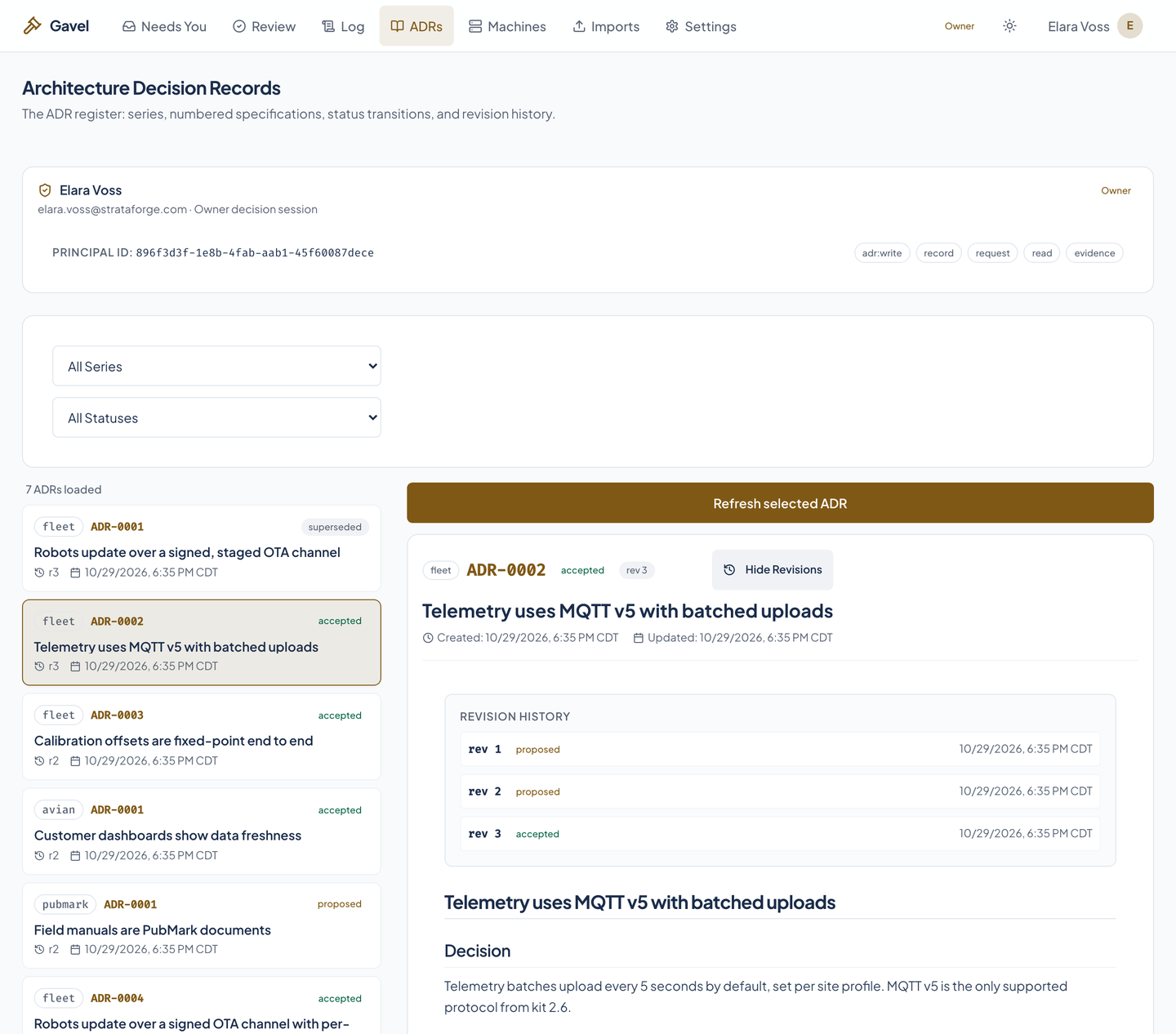
Numbers and the ledger: “Numbered per series.” The real ADR register, with the first two ADRs of one series ringed and seven marks, one per ADR, in three series that each count from 0001. “One allocator.” Two drawn plans ask one series for a number at the same time and take the next two. “Every record can go to git.” Three file names leave for a repository as PubMark files.
End card: “Proceed or hold. Always written down.” The mark, Gavel, the tagline, “Internal to Renkara. Not for sale.” and fleet@renkara.com, on the final chord.
The factory keeps moving while the owner is away.
An agent that needs a person does not stop and wait. It files an ask with its own recommendation and a default-by time, and keeps working on the recommendation. If the owner is there, he picks an option. If he is not, the ask closes on the recommendation, and he can still reverse it later.
The exception is deliberate: an ask that would deploy to production without an order, spend $20 or more, or delete generated data is held, never defaulted.
Rulings, reversals, and supersession, all in the history.
When the owner rules, Gavel records how: direct on the web, or relayed through a session with his verbatim words and the time he said them. When a newer decision replaces an older one, the old record stays, marked superseded, and points at its successor.
ADR numbers that cannot collide.
Plans used to claim the same ADR number. Gavel allocates numbers centrally, per series, and lets a plan reserve one before the record exists. Bodies are PubMark, revisions are kept, and a superseded record links to its replacement.
One place for the decisions that used to live in lane logs.
Gavel keeps agent decisions, owner asks, rulings, waivers, and architecture decision records in Postgres, with MCP tools for the agents and a web desk for the owner. These are the jobs it does today.
Records every decision
Agents log what they decided, why, how to undo it, and the evidence: commits, Docket cards, artifacts, and the session that made the call. The owner can confirm or reverse any of them later.
Asks without stalling
An ask carries options, a recommendation, and a default-by time. The agent proceeds on the recommendation at once; the owner confirms or reverses. Hard-gated actions hold instead.
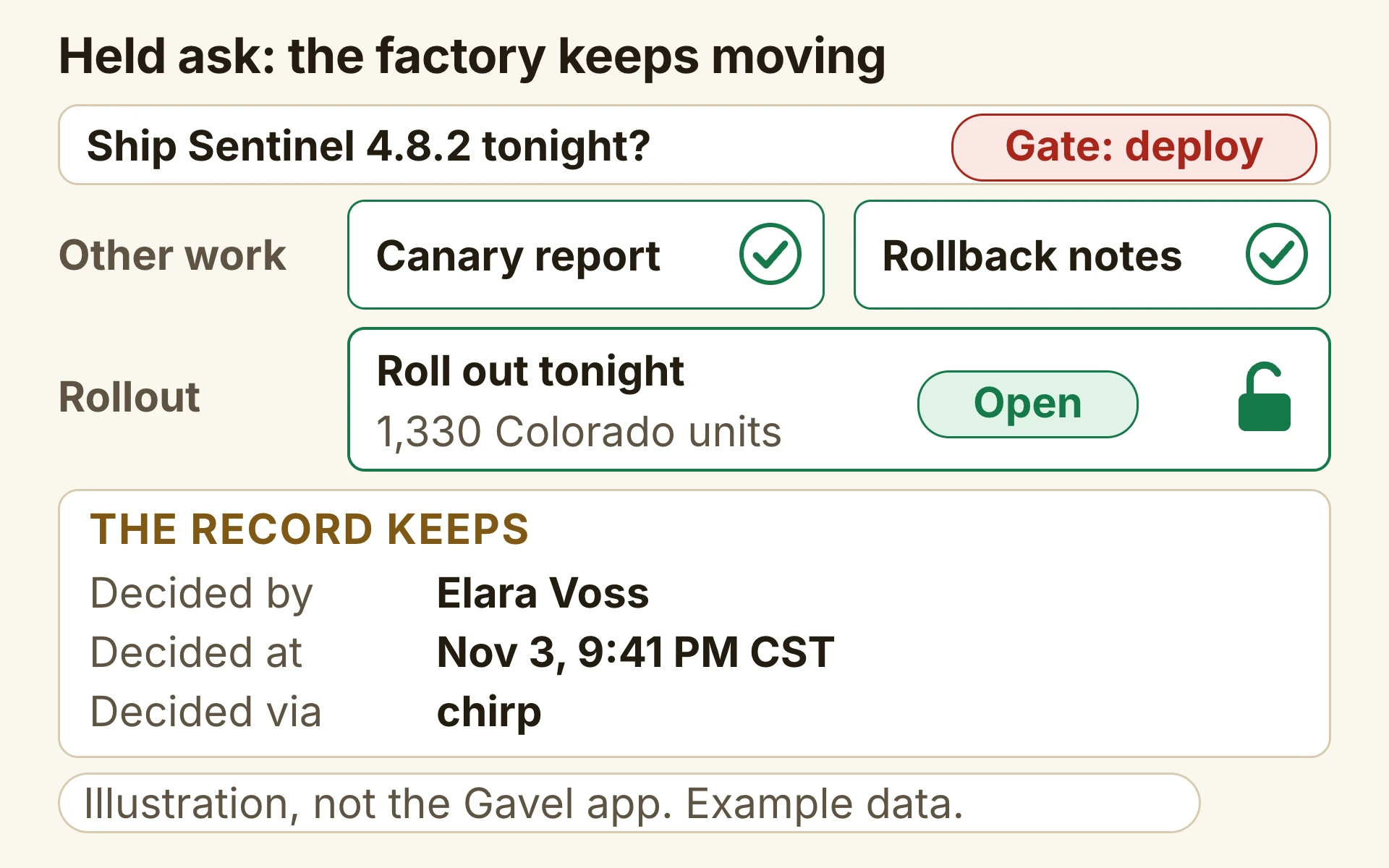
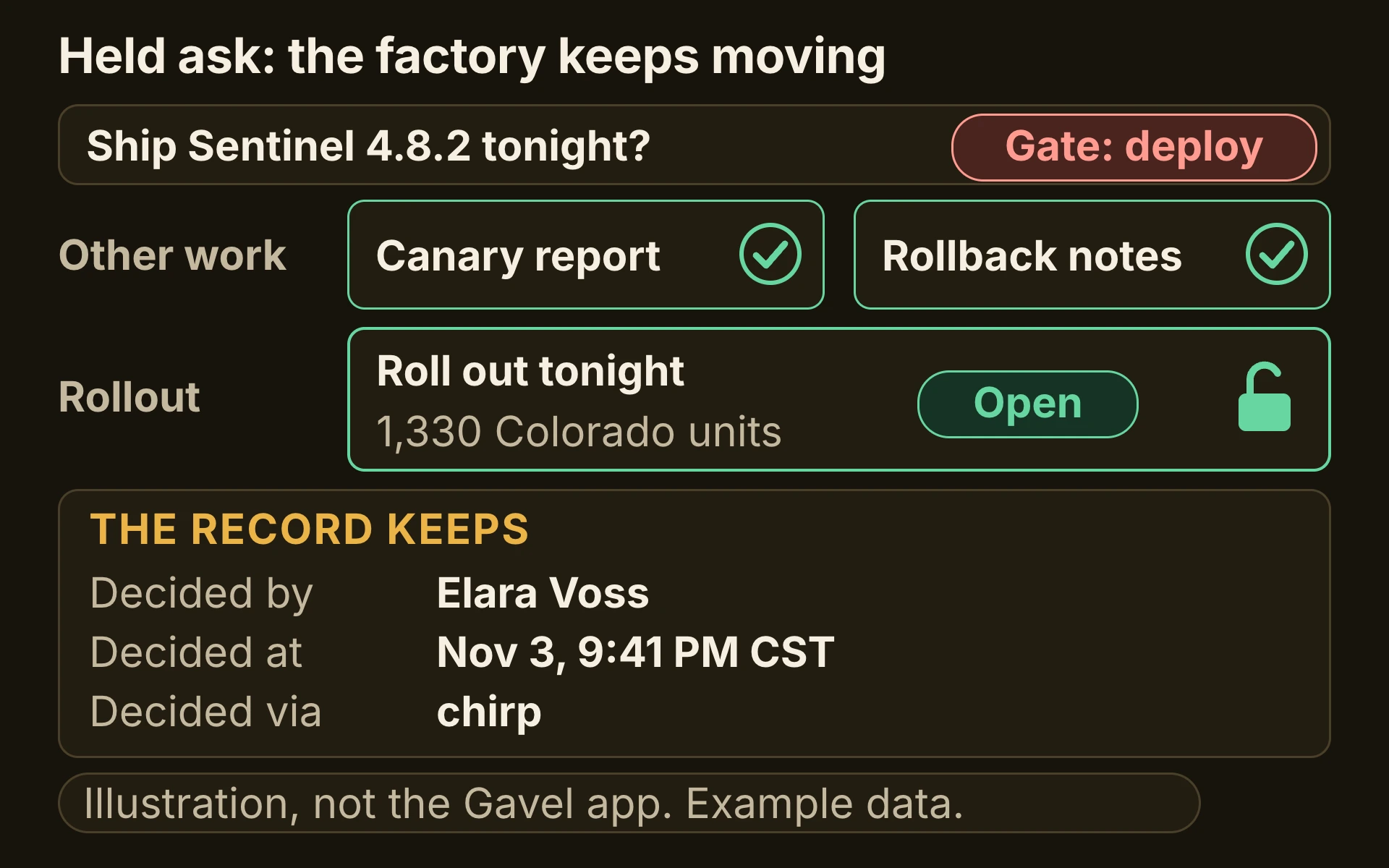
Illustration, not the Gavel app, with example data. An agent files an ask with a deploy gate: roll out Sentinel firmware 4.8.2 tonight, recommended, or wait for the Monday review, the safe default. The ask is held, so the rollout waits behind a lock while the agent's other work, a canary report and rollback notes, finishes. In Chirp the owner taps option A and confirms; the lock opens, and the record keeps who decided, when, and that it was by Chirp.
Keeps ADRs first-class
Numbered per series, revisioned, linked by supersession, with one allocator so two plans can never claim the same number again.
Links decisions to what the agent was doing
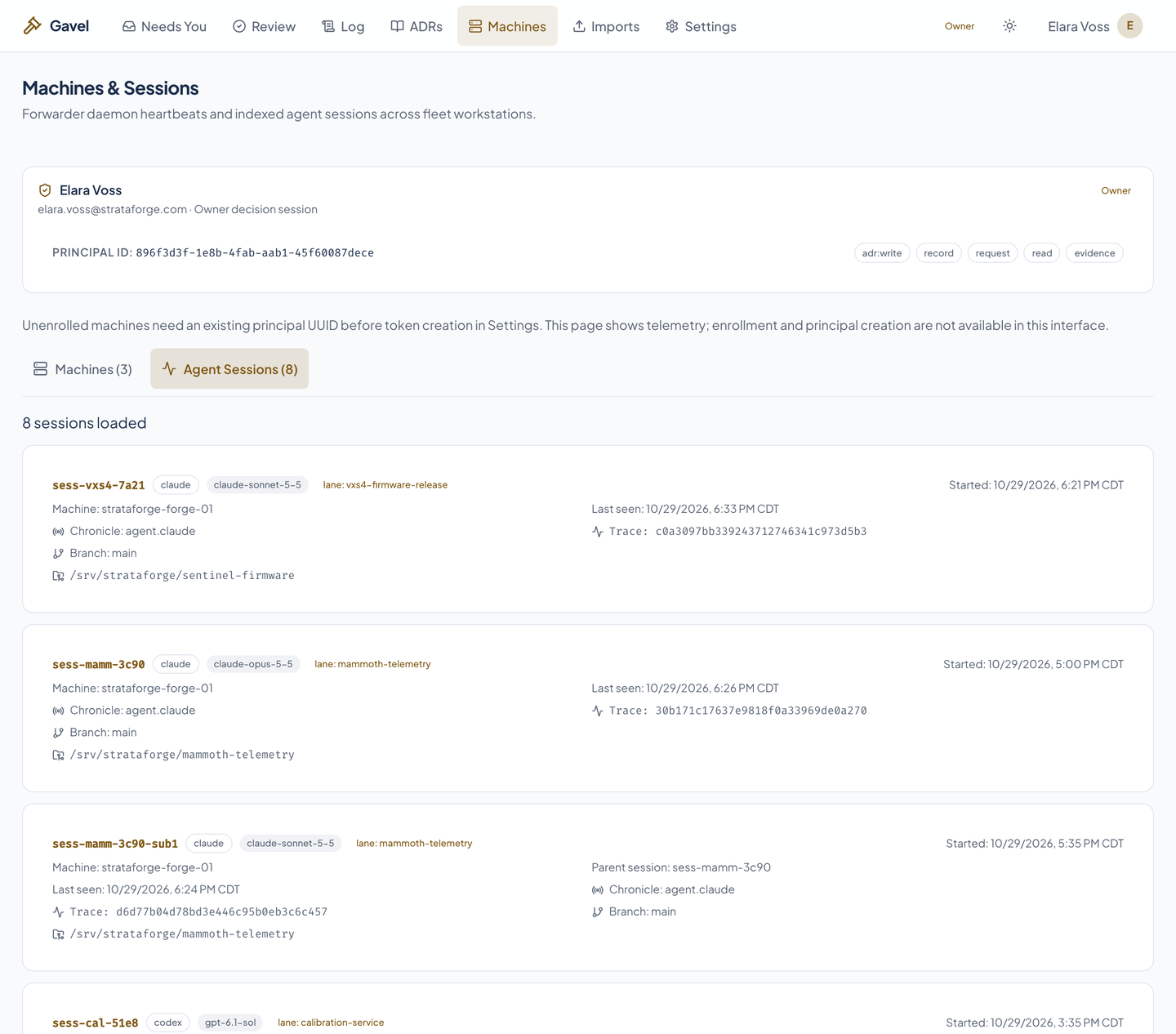
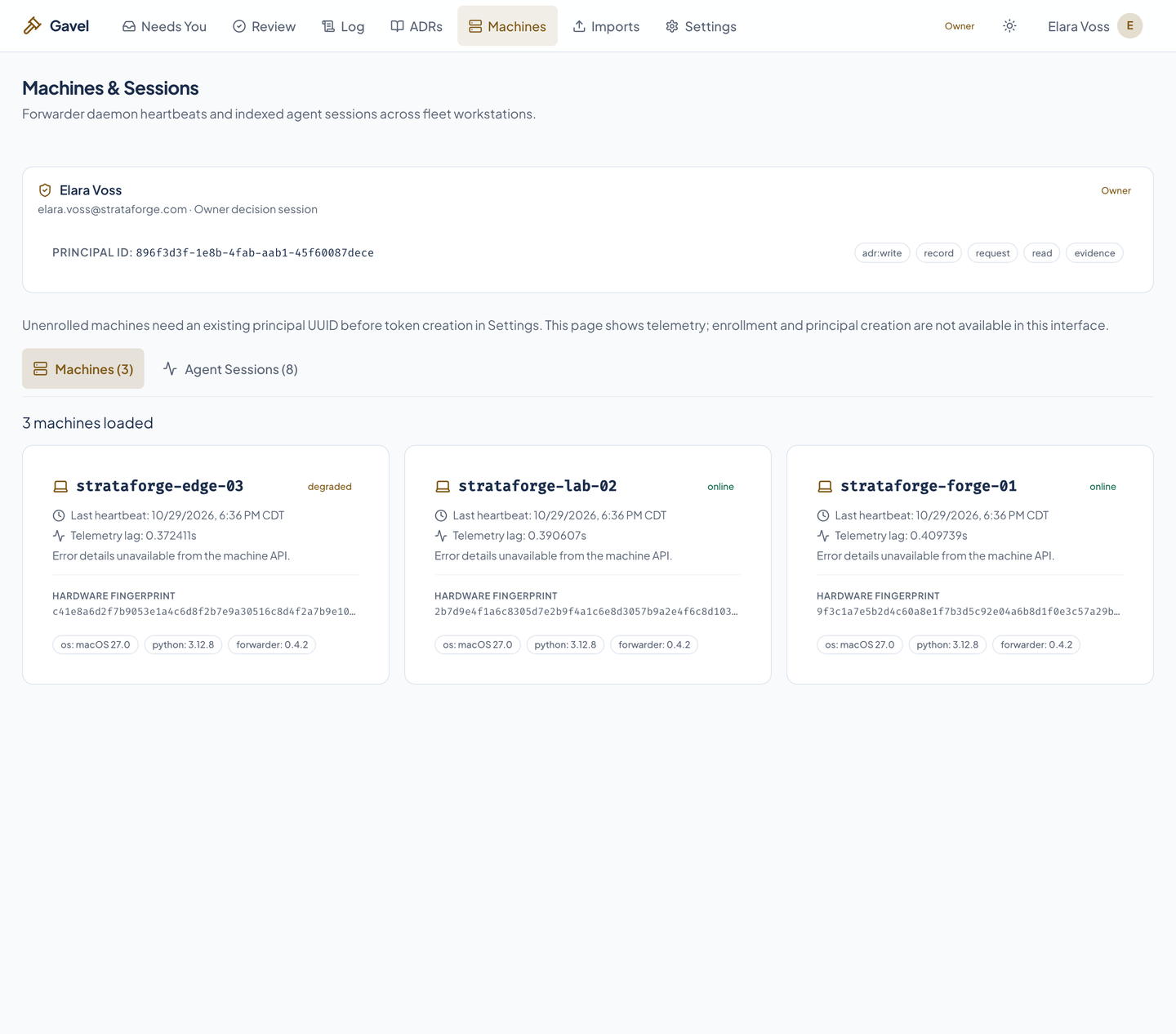
A forwarder on each machine ships redacted, structured events to Chronicle. Gavel ties each decision to its session and time window and pulls bounded excerpts on demand.
Append-only, owner-only
Records are never edited in place or deleted. Every change is a new revision in a hash chain, and only the owner can decide an ask.
- Exports to git every night
- Every record is written as a PubMark file to a ledger repository, so the history stays readable and restorable without Gavel running.
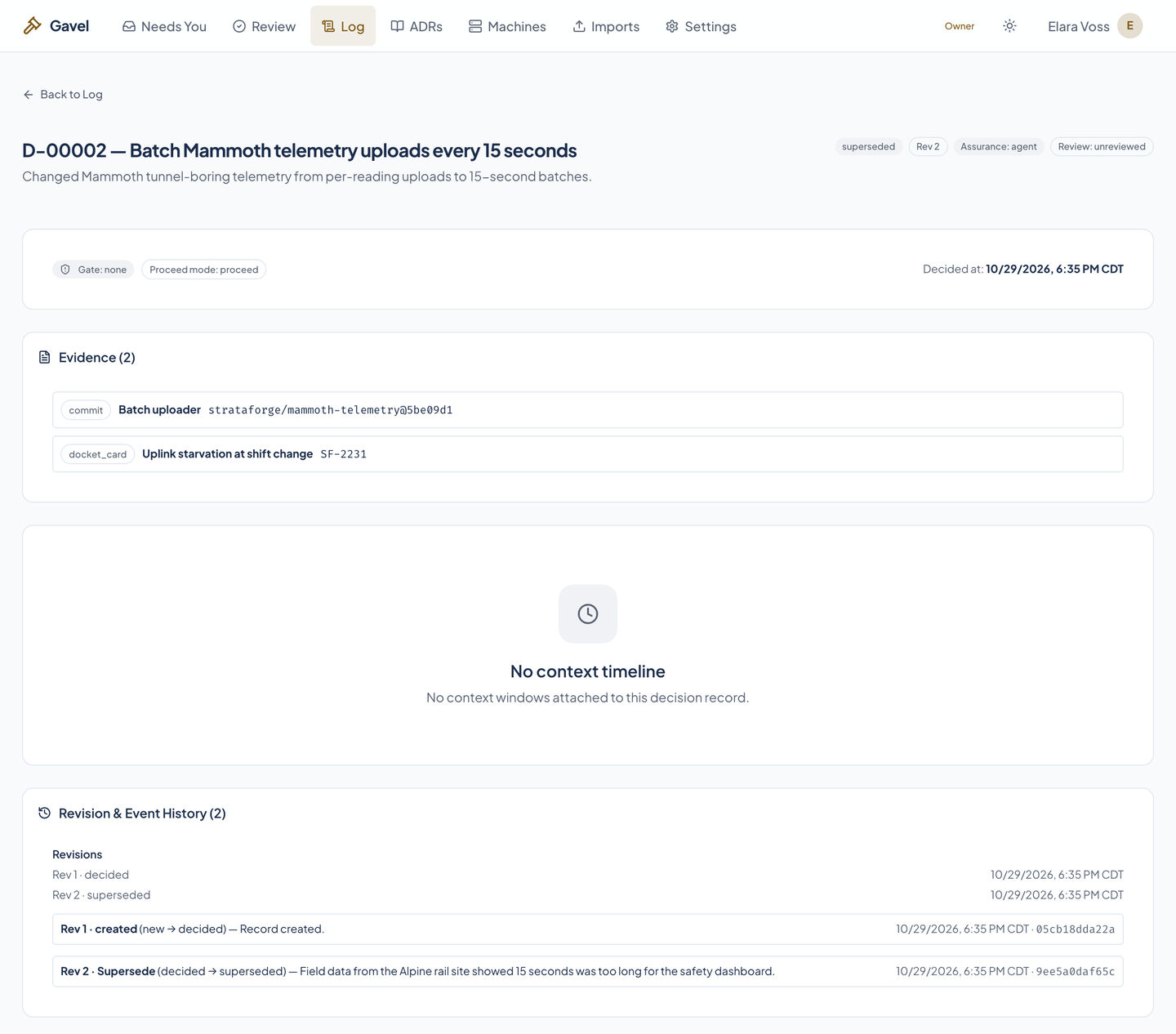
See it in light and dark
Real captures of the running tool, with fictional StrataForge Robotics data. They follow your theme.
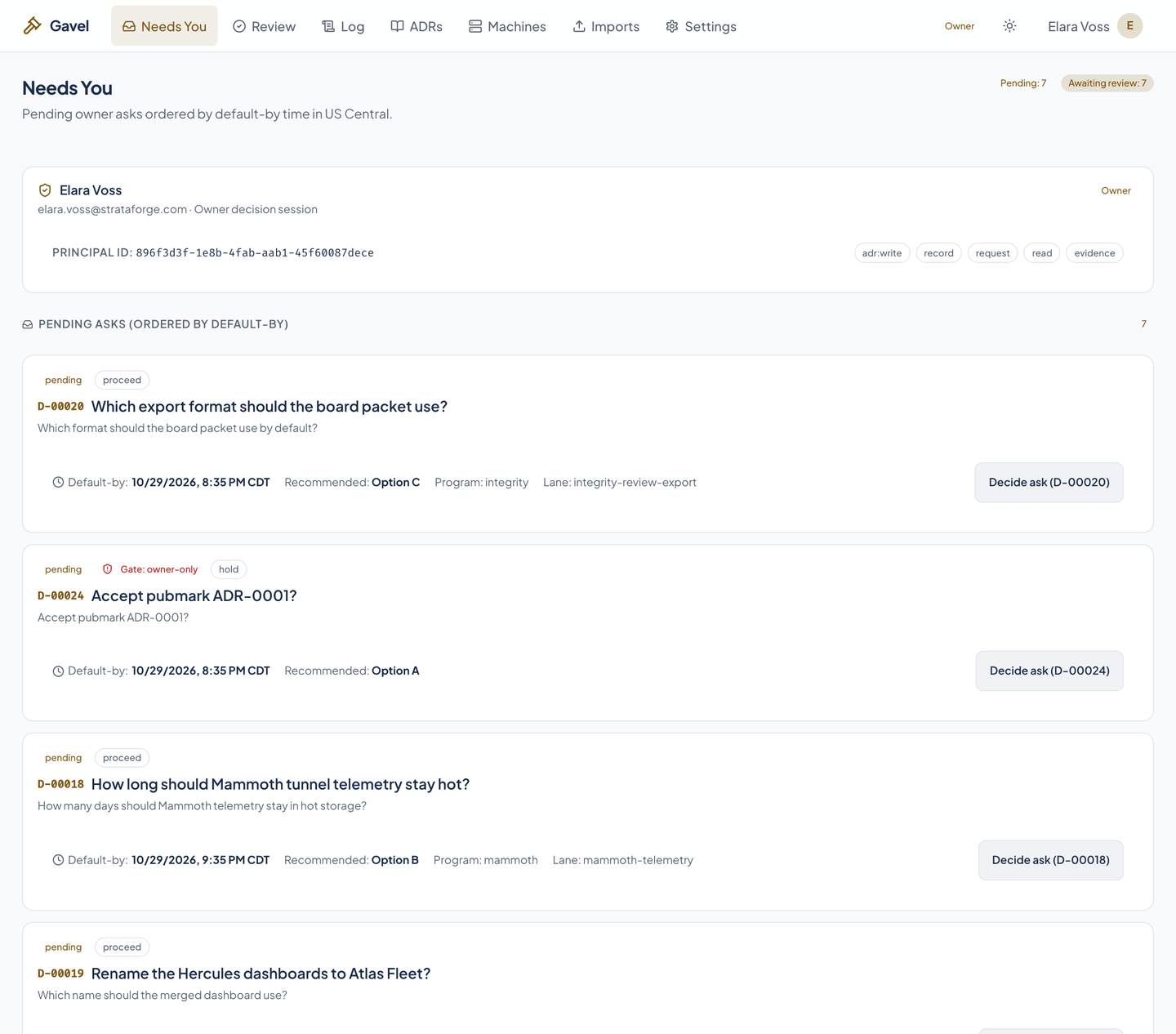
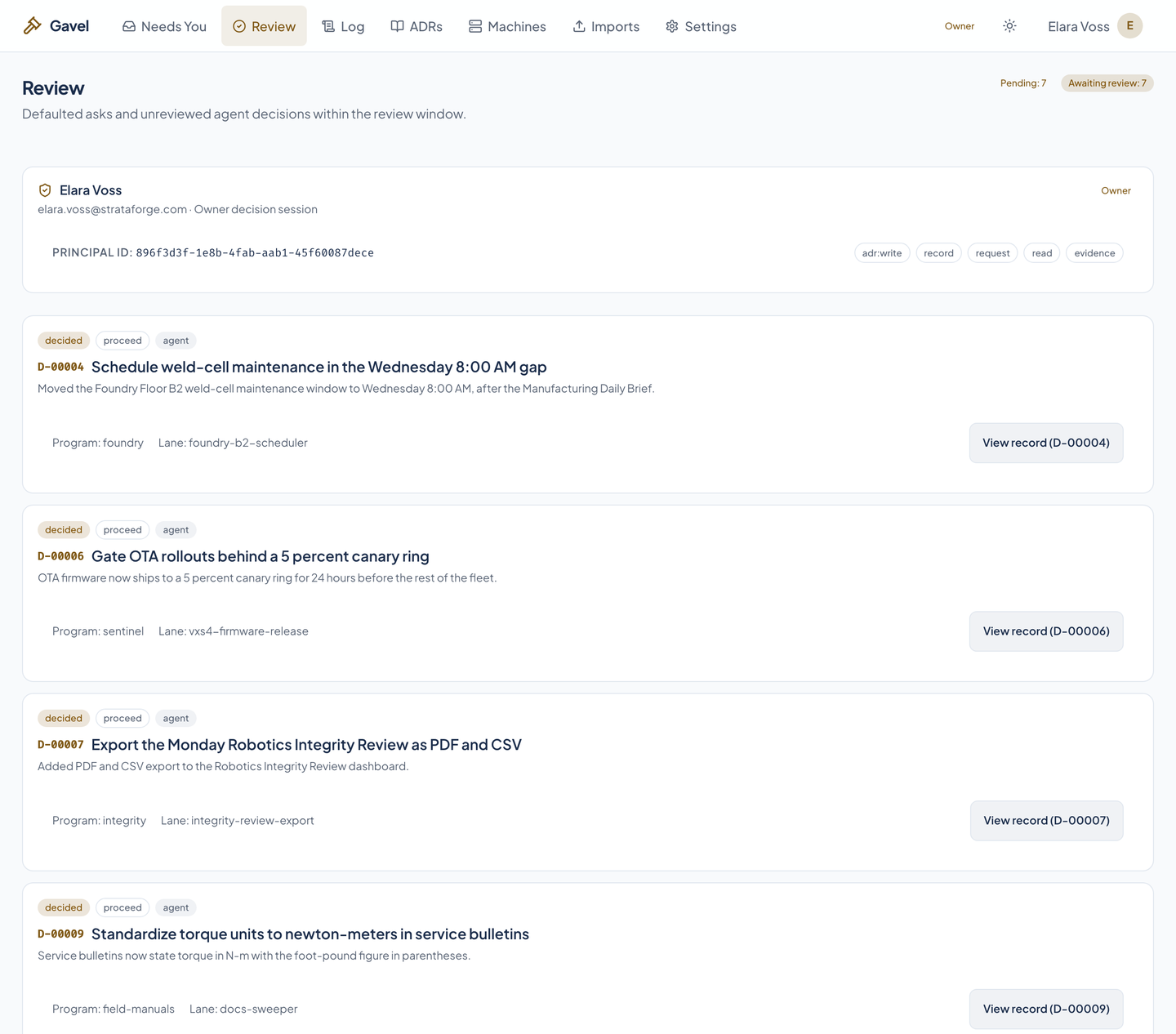
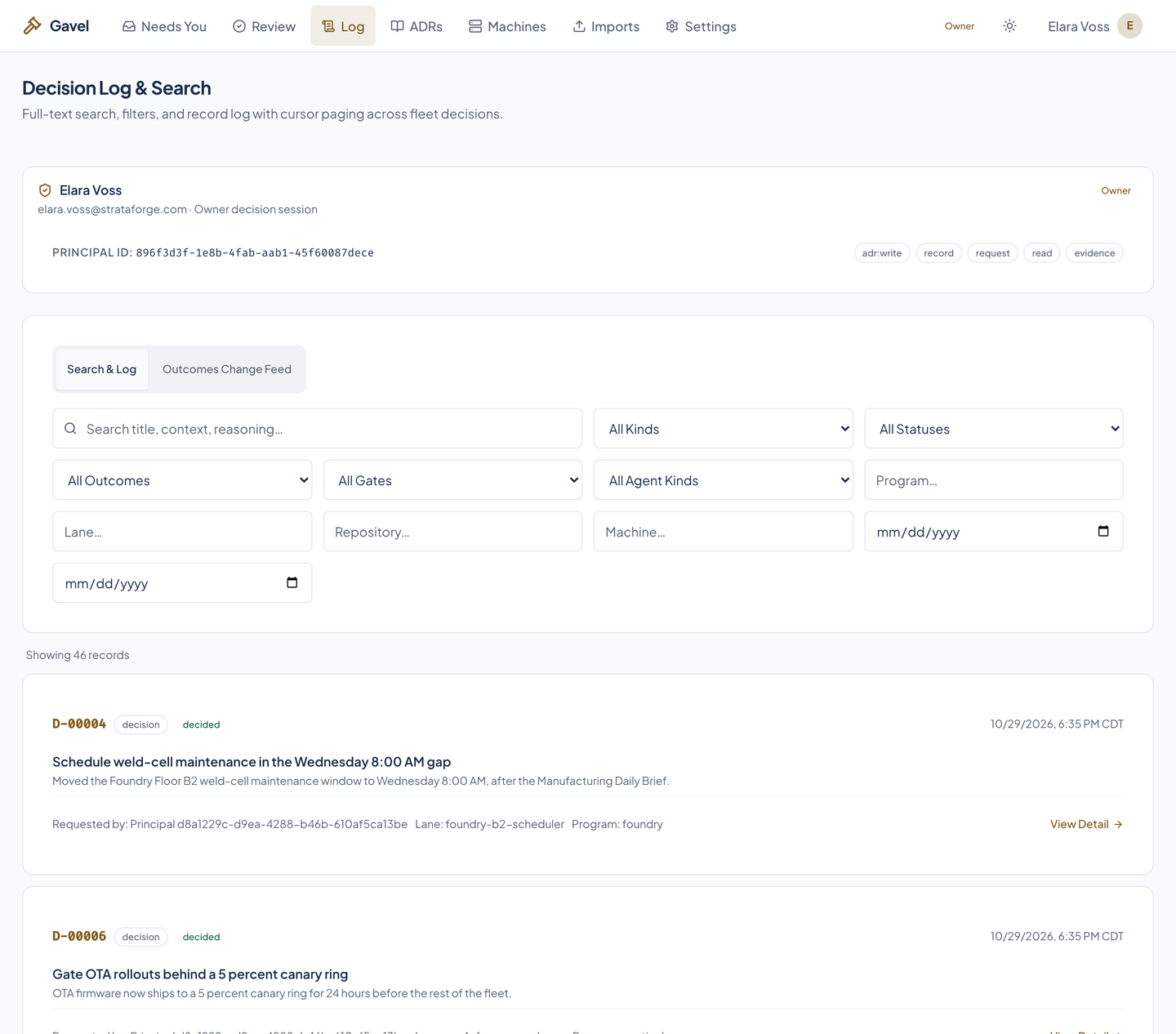
From a decision to the ledger
Record or ask
An agent records a decision, or files an ask with options, a recommendation, and a default-by time.
Proceed
The agent keeps working on its recommendation. A hard-gated ask holds instead of proceeding.
Rule
The owner confirms or reverses on the web desk or from Chirp, or the ask closes on the recommendation.
Export
Every record and revision is written as a PubMark file to a git ledger each night.
Built so everyone can use Gavel.
Gavel's web desk is built on the Renkara design system and checked with axe-core in light and dark at phone and desktop widths. Here is what the product supports today and what we have actually checked. We do not claim a WCAG conformance level for the product.
Partly supported
Keyboard operation
In the desk, dialogs keep Tab focus inside them and close on Escape, and focused controls show an indicator with at least 3:1 contrast.
Partly supported
Screen reader landmarks and labels
axe-core, which checks names, labels, and landmark structure, finds no serious or critical violations in the desk. It has not been tested with a screen reader.
Supported
Contrast in light and dark
Text and controls are checked for contrast in both the light and dark themes.
Not yet tested
Reduced motion
Gavel's interface uses the Renkara design system's motion presets, which are designed to honor the reduced-motion setting. Gavel's own tests do not check this yet.
Not yet tested
Text resize and zoom
Resizing text to 200 percent has not been tested.
Supported
Mobile and touch
The desk fits a 375 by 667 phone screen with no sideways scrolling, and its controls are at least 44 by 44 pixels.
Under the hood
| Backend |
|
|---|---|
| Agent interface |
|
| Web desk |
|
| Records and export |
|
| Stands in for | Decisions buried in lane logs, Hand-numbered ADR files |
Part of the Renkara fleet
- Chirp
Asks post to the #decisions channel as a decision card, and the owner's choice from Chirp comes back as the ruling.
- Chronicle
Receives the forwarder's redacted agent events; Gavel pulls bounded excerpts to show what the agent was doing.
- Vigil
Gavel ships a Vigil monitor for its service health.
- Roost
Relays Gavel's MCP tools to agents on every machine.
Built for agents as well as people
Agents record decisions, ask the owner, search the record, and manage ADRs through Gavel's MCP tools. They can record and ask; only the owner's answer decides.
Decisions and asks
record_decisionrequest_owner_decisiondecidesupersede_decisionwithdraw_requestadd_evidence
Reading the record
search_decisionslist_pendingget_decisionlist_outcomesget_decision_context
ADRs
create_adrreserve_adr_numberupdate_adrget_adrlist_adrs
Operations
check_service_healthget_diagnostics
Questions people ask
Is Gavel available to other teams?
No. Gavel is internal to Renkara and is not offered for sale. This site shows what it does and how it is built. Write to fleet@renkara.com with questions.
Is the data in the screenshots real?
No. Every screenshot is a capture of the running app against fictional StrataForge Robotics data.
What happens if the owner does not answer an ask?
A normal ask closes on the agent's recommendation at its default-by time, and the owner can still reverse it for a review window (seven days by default). An ask that would deploy to production without an order, spend $20 or more, or delete generated data is held: the agent does not proceed, and if nobody answers it closes on its one safe option, never on the gated one.
Questions about this tool?
Write to Renkara Media Group and a person will answer.